Bumper Cars vs Go-Karts: Key Differences Explained at a Glance
Bumper cars and go-karts are both popular attractions in amusement parks, family entertainment centers, shopping malls, and recreational venues. At first sight, they may appear similar because both involve small vehicles and interactive driving experiences. However, when examined more closely, bumper cars and go-karts differ significantly in terms of power source, reminder appearance, operating environment, and overall riding experience.
Understanding these core differences is essential for anyone planning an amusement project, operating a leisure venue, or simply wanting to choose the right attraction for a specific audience. By focusing on a few key aspects, it becomes easy to distinguish bumper cars from go-karts at a glance.

Power Source
Bumper Cars
Bumper cars are typically powered by electricity. In traditional amusement setups, they obtain power through an overhead conductive ceiling grid or a conductive floor system. Each car is equipped with a collector pole or contact device that connects to the power supply, allowing electricity to flow continuously while the vehicle is in operation.
Because the power comes from an external source, bumper cars are designed to operate at relatively low speeds. The electric system prioritizes stability and safety rather than acceleration or high performance. This power design ensures that vehicles can collide repeatedly without causing mechanical damage or safety risks to riders.
In modern installations, some bumper cars use onboard batteries instead of ceiling grids, especially in venues where visual aesthetics or installation constraints are important. Even with battery-powered designs, bumper cars remain low-speed vehicles intended for casual entertainment rather than competitive driving.

Go-Karts
Go-karts use independent power systems built directly into the vehicle. The most common power sources are internal combustion engines, such as gasoline engines, or electric motors powered by rechargeable batteries.
Gas-powered go-karts are known for stronger output and faster response, delivering a more intense driving sensation. Electric go-karts, on the other hand, offer smooth acceleration, quieter operation, and reduced emissions, making them increasingly popular for indoor tracks and urban environments.
Unlike bumper cars, go-karts do not rely on any external power infrastructure. Each kart operates independently, which allows for higher speeds and more dynamic performance. As a result, go-karts generally feel closer to real vehicles in terms of power delivery and driving response.
Appearance and Structure
Bumper cars have a compact and rounded appearance, designed primarily with safety and impact protection in mind. The most recognizable feature is the thick rubber or inflatable bumper that surrounds the entire vehicle. This protective skirt absorbs shocks during collisions, allowing riders to bump into each other safely.
Most bumper cars are semi-enclosed and can accommodate one or two riders. The seating position is upright, and the overall structure is sturdy and durable. Controls are simple, usually limited to a steering wheel and basic accelerator or brake pedals, making bumper cars easy to operate even for first-time riders.
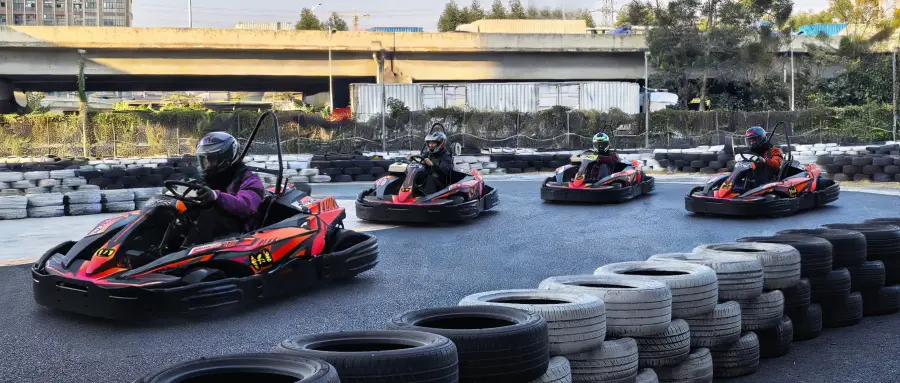
Go-karts, by contrast, feature a low-profile chassis and an open-frame design. The vehicle body is lightweight, and the driver sits close to the ground, which enhances stability and provides a stronger sense of speed. Most go-karts are single-seat vehicles, although some recreational models are designed for two riders.
The open structure of a go-kart exposes much of the frame and wheels, emphasizing performance and control rather than impact resistance. Because of this design, drivers are usually required to wear helmets and other protective equipment. The overall appearance reflects a focus on driving realism and racing-style experience.

Operating Environment
Bumper cars operate in relatively small and clearly defined areas. The riding surface is flat and smooth, and the entire area is enclosed by barriers to keep vehicles within a controlled zone. Bumper car arenas can be installed indoors or outdoors, depending on the venue, and they do not require complex track layouts.
Within the bumper car area, vehicles move freely without fixed routes. Riders are encouraged to collide, spin, and chase one another, which is a core part of the attraction. The limited space and controlled speed make bumper cars suitable for compact venues with high visitor turnover.
Go-karts require a dedicated track with a clearly planned layout. Tracks typically include straight sections, curves, and turns designed to guide vehicle movement. The length and width of a go-kart track depend on the available space and the type of karts being used, but they are generally much larger than bumper car areas.
Unlike bumper cars, go-karts follow a defined driving direction and lane system. Drivers must stay on the track and follow basic racing rules, which adds structure and order to the experience. The larger space requirement allows for higher speeds and longer driving sessions.

Gameplay and Positioning
Bumper cars are classified as amusement rides, with the primary goal of providing lighthearted fun and social interaction. The main appeal lies in playful collisions and unpredictable movement rather than competition or performance. Riders of different ages can enjoy the experience together, which makes bumper cars especially popular with children, teenagers, and families.
There is no concept of speed ranking, lap timing, or racing strategy in bumper car gameplay. The focus is purely on enjoyment and interaction, and rides are usually short, allowing many guests to participate within a short period of time.
Go-karts offer a more dynamic and skill-based experience. Compared to bumper cars, go-karts operate at higher speeds and require more precise control. Children’s go-karts typically run at around 25 km/h, while adult go-karts can reach speeds of 45 km/h or higher.
Driving a go-kart involves managing acceleration, braking, and steering in a way that closely resembles real-world driving. Players must pay attention to racing lines, cornering techniques, and overall control, which makes go-karting more competitive and performance-oriented. The experience appeals strongly to teenagers and adults who enjoy speed and driving challenges.

Summary
Although bumper cars and go-karts are both popular attractions within the amusement industry, they differ fundamentally in design, operation, and experience. Bumper cars emphasize safety, simplicity, and interactive fun, making them ideal for casual entertainment and family-oriented venues. Go-karts focus on speed, control, and driving realism, offering a more intense and skill-based experience.
By understanding the differences in power source, vehicle structure, operating environment, and gameplay positioning, it becomes much easier to choose the right attraction based on space, audience, and entertainment goals.



Leave a Reply
Want to join the discussion?Feel free to contribute!